
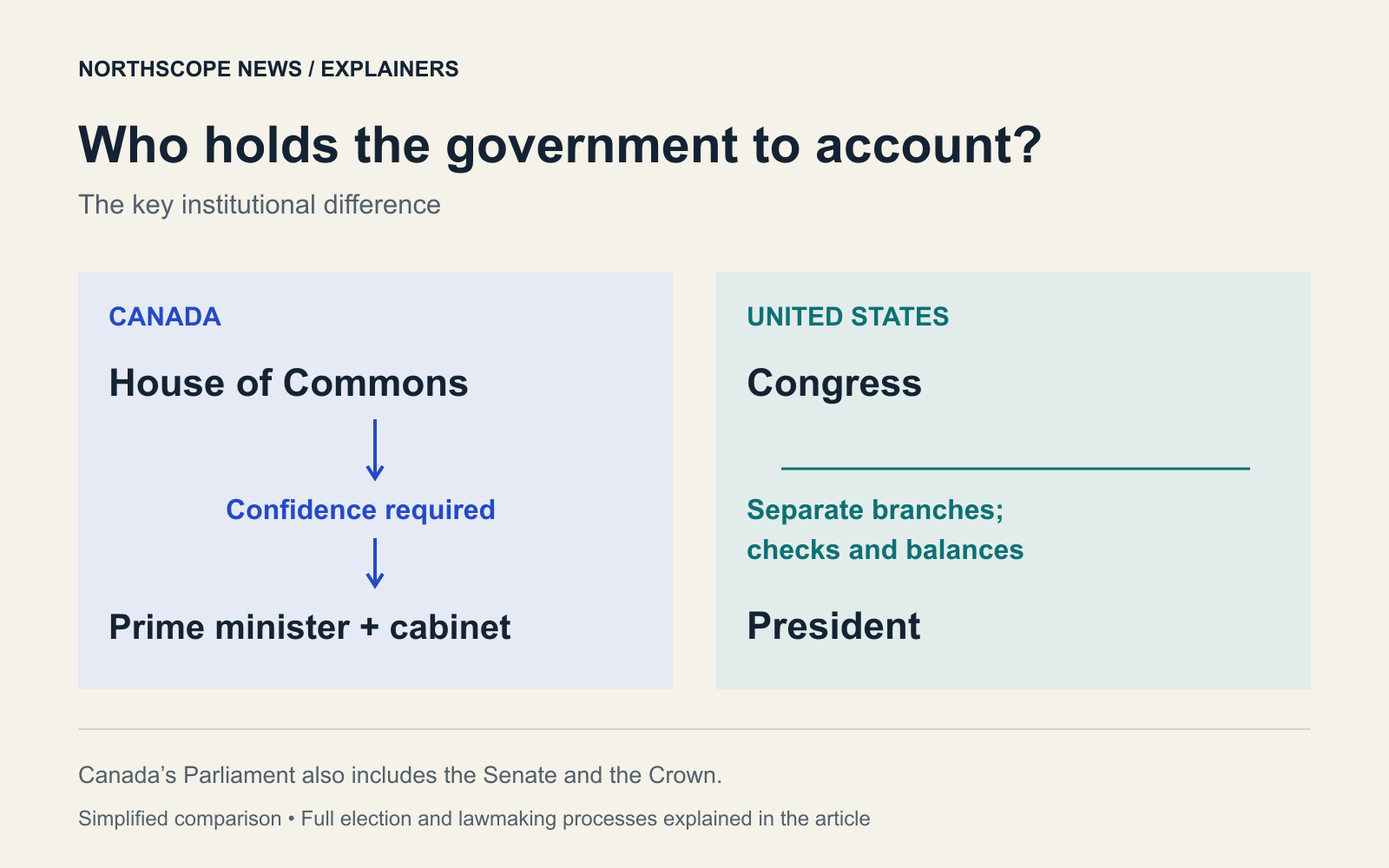
Original NorthScope News diagram. Simplified comparison based on the House of Commons of Canada and USAGov.
The central difference is how the executive stays in office. In Canada, the prime minister and cabinet must retain the confidence of the elected House of Commons. In the United States, the president leads a separate executive branch and does not depend on winning congressional confidence votes.
Both countries have two legislative chambers, but familiar labels can conceal different powers. A Canadian Senate appointment, a U.S. Senate vote and a Canadian confidence motion are not interchangeable events.
Parliament and Congress at a glance
| Canada | United States |
|---|---|
| Federal legislature Parliament: Crown, Senate and House of Commons | Federal legislature Congress: Senate and House of Representatives |
| Executive leadership Prime minister and cabinet | Executive leadership President |
| Upper chamber Appointed Senate | Upper chamber Elected Senate |
| Link to the legislature Government depends on Commons confidence | Link to the legislature Executive and legislature are separate branches |
Sources: the House of Commons guide to Canada’s system and USAGov’s explanation of the three branches.
Do Canadians elect their prime minister directly?
No. In a federal election, voters choose a member of Parliament for their riding. The governor general appoints the person most likely to command the House’s confidence as prime minister—usually the leader of the party with the most seats. Canada’s monarch is head of state, represented federally by the governor general; the prime minister leads the government. See the Canadian parliamentary framework.
In the United States, presidential elections are separate from elections to Congress. Voters choose a presidential candidate’s electors; those electors then vote through the Electoral College process. It is not simply a nationwide popular-vote contest. The National Archives explains the Electoral College.
Why does confidence matter in Canada?
Confidence is a constitutional convention: the government must be able to retain the support of the House of Commons. Explicit confidence motions and certain important financial votes can test that support. A government defeated on a confidence question is expected to resign or ask for Parliament to be dissolved so an election can be held. See the House’s guide to the confidence convention.
That does not mean every lost vote automatically triggers an election. The nature of the vote and the constitutional circumstances matter. A minority government must find enough support outside its own ranks to survive confidence tests; disagreement on another issue need not have the same consequence.
The U.S. relationship works differently. Congress makes laws and scrutinizes the executive, while the president heads the executive branch. Losing a vote on a proposed law is not equivalent to a Canadian government losing confidence. See the roles of the U.S. branches.
How does a bill become law?
Canada: a federal bill goes through readings, debate and scrutiny, including committee consideration. The Commons and Senate must agree to the same text, and the bill must receive royal assent. Passing one chamber is therefore an important step, but not the end of the legislative process. Follow the Canadian lawmaking process.
United States: both the House and Senate must pass the same bill before it goes to the president. The president may sign it or veto it. Congress can override a veto with the required two-thirds vote in each chamber. There are also rules for a bill the president neither signs nor vetoes, including an exception associated with congressional adjournment. Congress.gov explains presidential action.
For a hypothetical housing bill, the practical question is therefore more precise than whether a leader has announced support. Has legislation been introduced? Has either chamber amended it? Have both chambers agreed? Has the final approval occurred? Those steps distinguish a proposal from an enacted law.
Are the two senates equivalent?
No. Canada’s senators are appointed, while U.S. senators are elected. In the United States, each state elects two senators for six-year terms, with elections staggered. House members serve two-year terms. Congress’s chambers share the task of passing legislation but have distinct responsibilities: for example, the Senate handles confirmations and treaty approval. Canadian Senate overview; Congress.gov’s institutional overview.
The shared name therefore tells you less than the chamber’s method of selection, powers and place in the wider system. A story about one senate should be read in its own institutional setting.
What about courts and executive action?
Courts are another part of the picture. The U.S. judicial branch interprets laws and considers constitutional questions. A dispute can therefore continue after a political announcement or legislative vote. USAGov explains judicial responsibilities.
When reading a policy story, identify the instrument involved. An announcement, a bill, a law and a court ruling describe different stages or kinds of action. The article should explain the authority being used, the remaining steps and when any change takes effect.
A quick guide for reading political headlines
- “The government announced…” Look for the legal or legislative step behind the announcement.
- “The House passed…” Check which country and chamber, then whether further approval is needed.
- “The government lost a vote…” In Canada, establish whether it was a confidence question.
- “The Senate approved…” Check the senate’s role in that particular process.
For another institutional comparison, read how the Bank of Canada and Federal Reserve make rate decisions. Follow current developments in our Politics section.
Sources and scope
This guide covers the federal systems and their ordinary processes. It does not attempt to resolve every constitutional exception or describe a particular ongoing parliamentary dispute. The comparison diagram is simplified; the official sources linked above provide fuller explanations.
How this guide was prepared: AI-assisted writing and original graphics, checked against the official sources linked in the text on September 28, 2026. This is a source-based explainer, not original reporting. Read our editorial standards or report a correction.

