
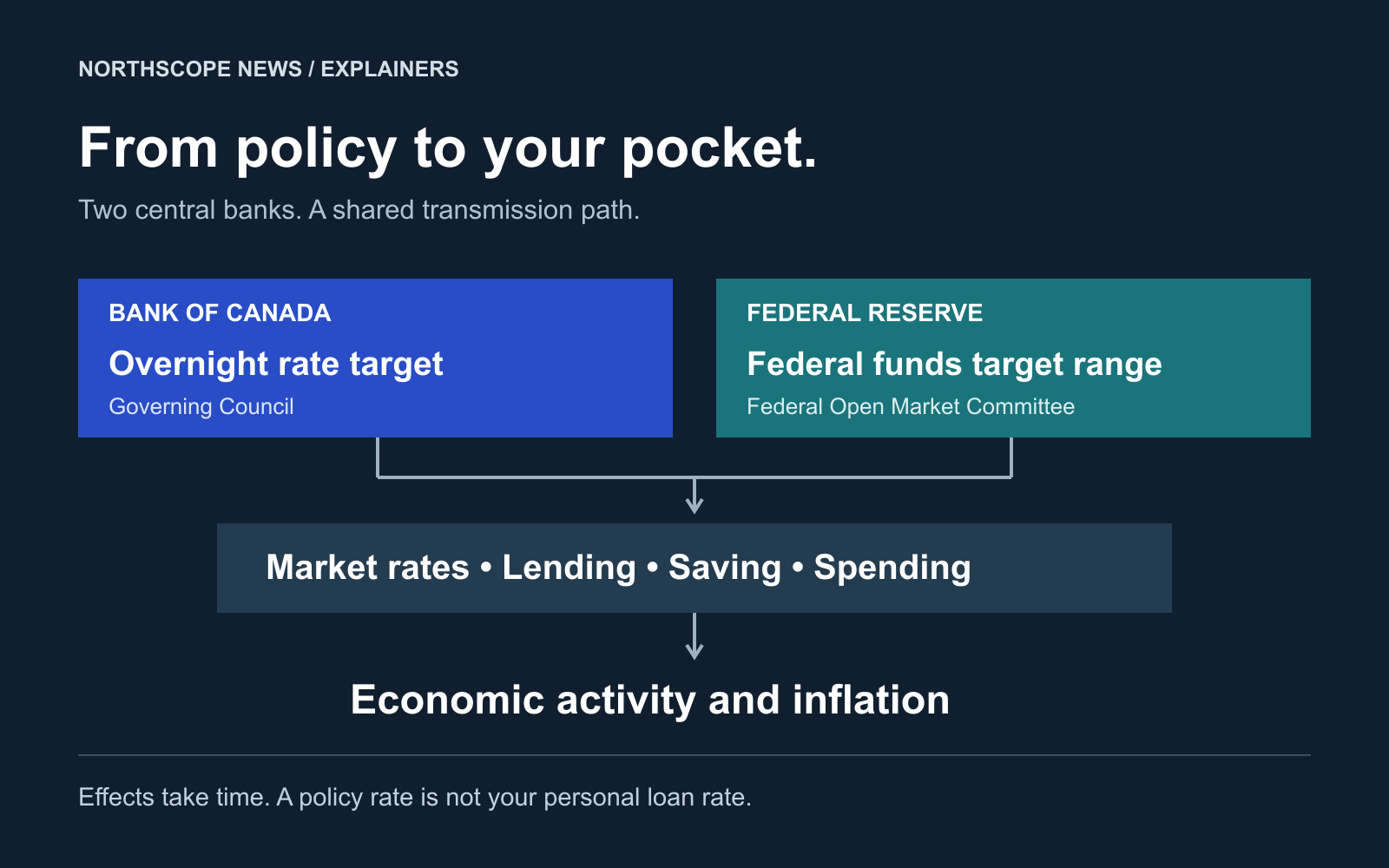
Original NorthScope News diagram. Simplified monetary-policy transmission, based on Bank of Canada and Federal Reserve explanations.
The short answer: Canada’s Governing Council sets the Bank of Canada’s policy interest rate. In the United States, the Federal Open Market Committee sets the Federal Reserve’s key target range. Both influence borrowing costs across the economy, but neither sets the price of every household loan.
A rate announcement is the start of a chain of effects. To understand it, separate three questions: who made the decision, which rate changed, and how that change reaches a borrower or saver.
The two systems at a glance
| Canada | United States |
|---|---|
| Decision-maker Bank of Canada Governing Council | Decision-maker Federal Open Market Committee (FOMC) |
| Headline policy setting Target for the overnight rate | Headline policy setting Target range for the federal funds rate |
| Inflation benchmark 2% target for total CPI inflation, within a 1%–3% range | Inflation benchmark 2% longer-run goal for PCE inflation |
| Decision process Consensus | Decision process Voting committee |
| Regular schedule Eight scheduled decisions a year | Regular schedule Eight scheduled meetings a year |
Sources for this comparison: Bank of Canada policy framework, Canadian decision process, FOMC structure and the Fed’s longer-run goals. Both banks can act outside their regular schedules.
Who decides in Canada?
The Bank of Canada’s Governing Council reviews forecasts, economic data, business and household surveys, and risks before agreeing on a decision by consensus. The governor communicates that decision, but the process draws on a much wider body of analysis. The Bank describes its decision process here.
The inflation target is agreed with the federal government; day-to-day monetary-policy decisions are made independently by the Bank. Under the framework in force through December 31, 2026, keeping inflation low and stable is central to supporting sustainable employment. The target concerns the rate of price increases, rather than a promise to restore an earlier price level. See the Canadian framework.
Who decides in the United States?
The FOMC’s voting membership consists of the Fed’s governors, the president of the New York Fed and four other regional Reserve Bank presidents on a rotating basis. Other regional presidents also take part in discussions. See how the committee is organized.
Its headline decision sets a range for the federal funds rate, an overnight interbank rate. The committee also decides on the Fed’s asset holdings and communicates its policy outlook. The Fed explains the FOMC’s role.
The Fed’s strategy seeks maximum employment and stable prices. Its 2% inflation goal uses the PCE price index, not the U.S. CPI that often leads news coverage. Employment does not have a single fixed numerical target. The committee assesses multiple indicators and the risks around its outlook. See the Fed’s strategy statement, reaffirmed in January 2026.
How does a rate decision reach the economy?
Higher borrowing costs generally discourage spending and borrowing; lower costs tend to support them. Policy also works through asset prices, exchange rates and expectations. These effects unfold at different speeds, so a decision cannot be judged solely by the next inflation release. The Bank of Canada says the full effect of its policy changes usually takes 18–24 months, although the timing varies. Read its explanation of monetary-policy transmission.
Why might your mortgage rate or payment stay the same?
In Canada, lenders’ prime rates help determine variable mortgage rates, while a fixed mortgage rate stays fixed for the agreed term. Rates offered on new mortgages also depend on lenders’ funding costs, competition and borrower risk. A policy-rate cut therefore does not guarantee an identical reduction in every advertised loan rate. The Bank of Canada explains what determines mortgage rates.
For a particular loan, the contract matters: which reference rate it uses, when it resets, and whether a change affects the payment or the interest portion. The headline policy rate alone cannot answer those questions.
What does a 25-basis-point cut mean?
One basis point is 0.01 percentage point. A hypothetical move from 4.00% to 3.75% is a reduction of 25 basis points, or 0.25 percentage point. It is not a 25% cut.
As simple arithmetic, a 0.25-percentage-point reduction on an unchanged $10,000 balance equals $25 less interest over a full year. That example assumes simple interest, no repayments and the entire reduction reaching the loan. It is not a mortgage-payment estimate.
How to read the next rate announcement
- Identify the exact rate or range, the size of the change and its effective date.
- Separate the decision made today from forecasts or comments about what might happen next.
- Read the explanation for the decision: inflation, employment, growth and uncertainty may pull in different directions.
- Check the terms of your own loan or savings product before translating a headline into a dollar amount.
For the prices behind these decisions, read why falling inflation can still leave prices higher. For the institutions around economic policy, see Parliament vs. Congress.
Sources and scope
This guide explains the process rather than quoting current policy rates or predicting the next decision. Monetary-policy frameworks can change; Canada’s agreement is due for renewal at the end of 2026. The numerical loan example is illustrative.
How this guide was prepared: AI-assisted writing and original graphics, checked against the official sources linked in the text on September 28, 2026. This is a source-based explainer, not original reporting. Read our editorial standards or report a correction.

